Practical Everyday English: Advanced Vocabulary Mastery Guide
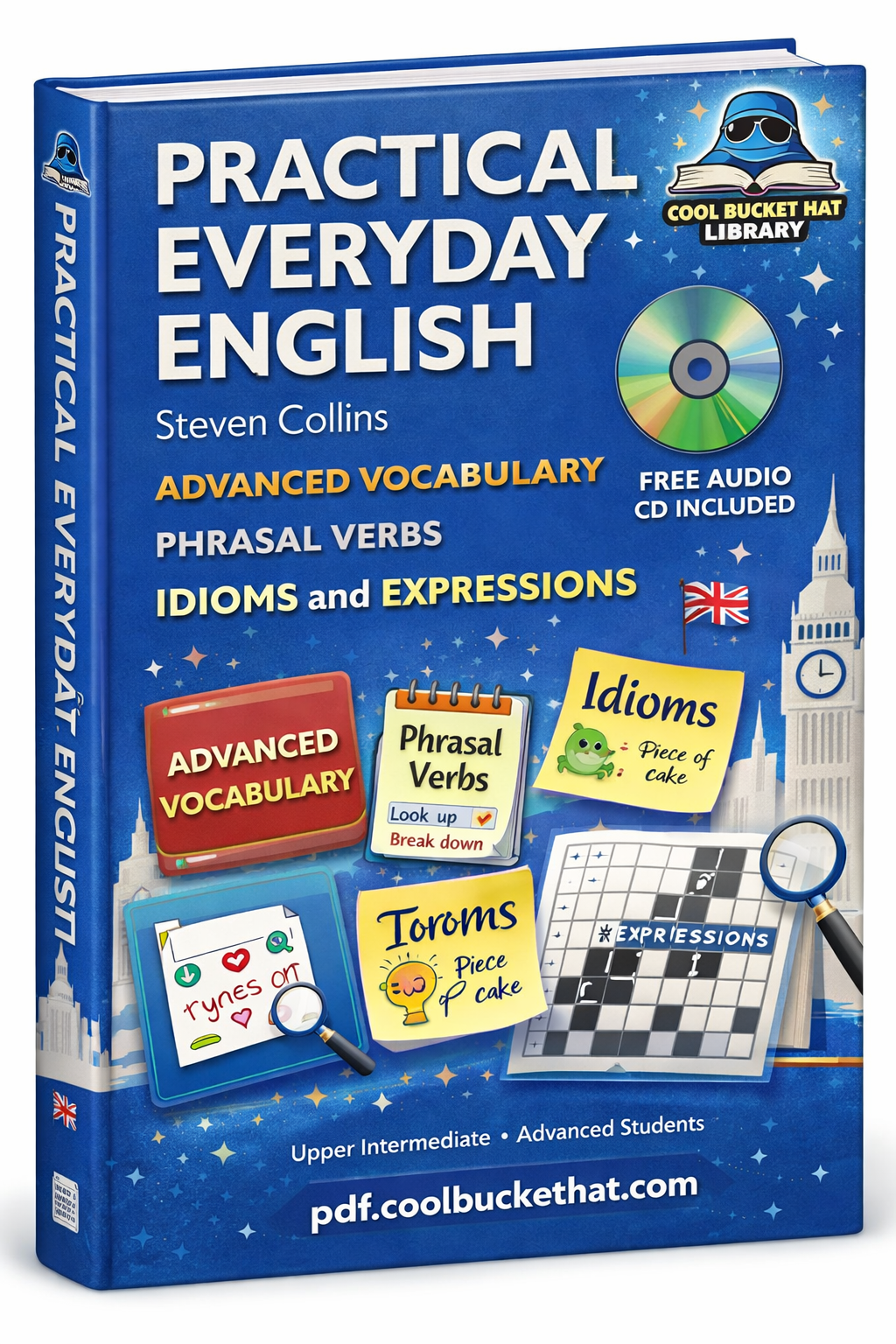
Practical Everyday English: Advanced Vocabulary, Phrasal Verbs, Idioms and Expressions is a powerful learning resource designed for learners who want to move beyond basic communication and achieve true fluency. At the advanced stage of language learning, simple grammar and everyday vocabulary are no longer enough. Communication must become more precise, natural, and expressive. This is where advanced vocabulary, idiomatic language, and phrasal verb mastery become essential.
Many English learners reach a point where they can understand conversations but struggle to express complex ideas clearly. Their speech may sound correct but not natural. Their writing may be accurate but not expressive. To overcome this plateau, learners must develop deeper language awareness. They must learn how native speakers actually communicate in real contexts.
This guide explores how advanced vocabulary learning improves fluency, why idioms and expressions matter, and how structured practice leads to confident, natural communication.
Why Advanced Vocabulary Is Essential for Fluency
Basic vocabulary allows simple communication. However, advanced vocabulary allows precise expression. It helps speakers communicate opinions, emotions, and detailed ideas effectively.
For example, instead of saying “very good,” advanced vocabulary offers alternatives such as “excellent,” “outstanding,” or “remarkable.” Each word carries a slightly different meaning. These subtle differences improve clarity and sophistication.
As language proficiency grows, communication becomes more nuanced. Learners can describe experiences more vividly. They can explain complex thoughts more clearly. They can participate in deeper discussions.
Because of this, advanced vocabulary is not just an academic skill. It is a practical tool for real-world communication.
The Role of Phrasal Verbs in Natural Speech
Phrasal verbs are a defining feature of everyday English. They appear frequently in both informal and formal communication. Native speakers use them naturally, often without conscious effort.
However, phrasal verbs can be difficult to learn because their meanings are not always literal. For instance, “break down” may refer to emotional distress, mechanical failure, or detailed explanation depending on context.
Structured learning is necessary to understand these variations. Resources like Oxford University Press often emphasize contextual learning to make phrasal verbs easier to understand and remember.
When learners master phrasal verbs, their speech becomes more natural. Conversations flow more smoothly. Listening comprehension also improves because common expressions are recognized quickly.
Idioms Add Depth and Cultural Meaning
Idioms are expressions whose meanings cannot be understood from individual words alone. They reflect culture, history, and shared experiences. Because of this, they add personality and richness to communication.
For example, phrases such as “spill the beans” or “hit the nail on the head” carry meanings that go beyond literal interpretation. Without idiomatic knowledge, learners may understand words but miss intended meaning.
Idioms are especially common in spoken language, media, and informal writing. Learning them improves cultural understanding as well as language fluency.
Organizations like British Council often highlight idiomatic usage as an important step toward advanced proficiency.
When idioms are used correctly, communication becomes more expressive and engaging.
Expressions That Shape Real Communication
Language is not just a collection of words. It is a system of patterns and expressions that convey meaning efficiently. Fixed expressions, collocations, and conversational phrases are used constantly in everyday speech.
For example, native speakers say “make a decision,” not “do a decision.” These combinations must be learned as natural patterns rather than individual words.
Learning expressions improves fluency because speech becomes automatic. Instead of constructing sentences word by word, learners use familiar language chunks.
This is one of the key learning benefits highlighted in Practical Everyday English: Advanced Vocabulary, Phrasal Verbs, Idioms and Expressions, where structured exposure to real language patterns supports natural communication.
Learning Vocabulary in Context
Memorizing word lists rarely leads to long-term retention. Vocabulary must be learned in context to be meaningful.
Context shows how words function in real communication. It reveals tone, usage, and grammatical patterns. When vocabulary is connected to situations, memory becomes stronger.
For example, learning vocabulary related to business communication, travel experiences, or academic discussion makes language practical and relevant.
Modern learning platforms such as Duolingo often use contextual learning because it improves retention and engagement.
Through contextual practice, advanced vocabulary becomes part of active language use.
Structured Learning for Advanced Language Development
Advanced language learning requires organization. Without structure, learners may feel overwhelmed by the large number of expressions and patterns.
Systematic learning organizes vocabulary into themes and functional groups. Related expressions are studied together. Gradual progression ensures understanding.
The structured approach presented in Practical Everyday English: Advanced Vocabulary, Phrasal Verbs, Idioms and Expressions helps learners build knowledge step by step. This method reduces confusion and supports consistent progress.
When learning is organized, motivation increases. Progress becomes measurable and achievable.
Improving Speaking Confidence Through Rich Language
Confidence grows when learners have the language tools to express themselves fully. Limited vocabulary restricts expression. Advanced vocabulary expands possibilities.
When learners can choose precise words and natural expressions, communication becomes more fluid. Conversations feel more comfortable. Ideas are shared more effectively.
Confidence also improves listening comprehension. Recognizing idioms and phrasal verbs makes conversations easier to follow.
Over time, language becomes a natural communication tool rather than a subject of study.
Enhancing Writing Clarity and Style
Advanced vocabulary also transforms writing. Essays, emails, and reports become more engaging and professional.
Precise word choice improves clarity. Idiomatic expressions add personality. Natural collocations enhance readability.
Writers who use varied vocabulary avoid repetition. Their writing becomes more dynamic and persuasive.
These improvements are especially important in academic and professional environments where clear communication is essential.
Overcoming the Intermediate Plateau
Many learners experience a plateau after reaching intermediate level. Progress slows. Communication feels repetitive. Motivation may decrease.
This stage occurs because basic language skills are already developed. However, advanced features have not yet been mastered.
Expanding vocabulary and mastering expressions provide the next stage of growth. Communication becomes richer and more flexible.
Consistent study using Practical Everyday English: Advanced Vocabulary, Phrasal Verbs, Idioms and Expressions helps learners move beyond this plateau and continue improving.
Practical Strategies for Learning Advanced Language
Effective learning requires active practice. Passive reading alone is not enough.
Helpful strategies include:
Using new vocabulary in conversation
Writing sentences with idioms and phrasal verbs
Listening to authentic spoken English
Recording and reviewing personal speech
Practicing real-life scenarios
These strategies reinforce learning through repeated application.
Consistency is the key to long-term success.
Benefits of Mastering Advanced Everyday English
Learners who develop advanced vocabulary and expressions often experience significant communication improvements.
These include:
Greater speaking fluency
More natural conversational style
Improved listening comprehension
Stronger writing skills
Increased confidence in professional settings
These benefits accumulate gradually. However, consistent practice produces lasting results.
Who Should Focus on Advanced Vocabulary Learning?
Advanced language development benefits many types of learners, including:
Professionals working in international environments
Students preparing for academic study
Language enthusiasts seeking fluency
Advanced learners refining communication skills
Anyone aiming for natural, native-like expression
Because advanced language supports precise communication, it is valuable in every field.
Long-Term Impact on Language Mastery
Fluency is not achieved through grammar alone. It requires expressive vocabulary, natural phrasing, and cultural awareness.
Mastering advanced expressions transforms communication. Conversations become more engaging. Ideas are expressed more clearly. Language becomes flexible and dynamic.
With consistent practice, learners achieve a level of communication that feels effortless and authentic.
The structured learning approach provided in Practical Everyday English: Advanced Vocabulary, Phrasal Verbs, Idioms and Expressions supports this long-term transformation.
Final Thoughts
Advanced language learning is the key to natural and confident communication. Vocabulary depth, idiomatic knowledge, and phrasal verb mastery allow learners to express ideas with precision and clarity.
By learning language in context, practicing consistently, and using structured resources, learners move beyond basic communication toward true fluency.
Practical Everyday English: Advanced Vocabulary, Phrasal Verbs, Idioms and Expressions provides the guidance needed to achieve this level of mastery. With dedication and practice, learners can transform their communication skills and speak English with confidence, accuracy, and natural expression.